Tuesday, January 30, 2018

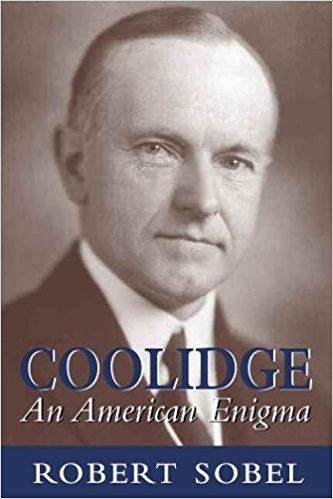
Review of Coolidge: An American Enigma by Robert Sobel


“American intellectuals do not so much harbor a negative opinion of Calvin Coolidge as they trivialize him. He often is dismissed as a political naif, simpleton, and lazy misfit, a relic from the nineteenth century, whose administration set the stage for the Great Depression. Most of the time, however, he simply isn’t taken very seriously.”  So begins Robert Sobel’s 1998 biography Coolidge: An American Enigma.  In the introduction, Sobel also discusses the long-held belief that Coolidge was a reactionary whose policies heavily favored big business.  Sobel takes issue with all of these stereotypes, arguing instead that Coolidge was an intelligent and complicated man who was “capable of holding dissonant views on some subjects” and who was much more progressive than he is generally given credit for (8). Sobel also argues that Coolidge was “the last president who believed in a passive executive branch in times of peace and prosperity” and that of all our twentieth-century presidents, Coolidge was “the most Jeffersonian in philosophy and practice—a judgment those who admire Jefferson but have not delved deeply into his writings may find astonishing” (14).

Sobel follows his introduction with a brief overview of Coolidge’s humble upbringing. The boyhoods of many of our presidents included great hardships, and Coolidge’s was no exception; he lost his mother at the age of 12 and had asthma and frequent colds throughout his early life.  In secondary school, Coolidge was extremely shy and was a good, though not an outstanding, student.  He did better in college, graduating cum laude. After graduation, Coolidge followed the common practice of apprenticing with a local law firm.  He was admitted to the bar in 1898 and soon afterward opened a law practice in Northampton, Massachusetts.

The same year, Coolidge began his political career by being elected to the Northampton City Council. After serving in this and other municipal positions, Coolidge was elected to the Massachusetts House of Representatives.  After serving two years, Coolidge ran for and was elected Mayor of Northampton.  After two more years, Coolidge in 1912 ran for the state senate, defeating his opponent handily.   Coolidge continued to rise through the state hierarchy, being elected President of the Massachusetts Senate in 1914, Lieutenant Governor in 1915, and Governor in 1918.  During his 20 years of service in local and state offices. Coolidge supported pro-labor legislation, better wages and hours for workers, medical care for the poor and suffering, factory regulation, higher wages for teachers, and even unionization.  These efforts of Coolidge were in direct line with progressive thought and show him to be far from a reactionary during his pre-Washington years.  In Sobel’s words, Coolidge “was not the tool of big business that he has become in today’s legend” (118).

Coolidge’s tenure as governor was characterized by “honesty, integrity, and incorruptibility” (156).   His successful suppression of the 1919 Boston Police Strike vaulted him to national prominence and resulted in his being named as the Republican vice presidential candidate in 1920. At this time, Coolidge’s political views were becoming more conservative and less progressive along with those of most of the rest of the nation.  As was the practice at the time, Vice President Coolidge performed few duties other than ceremonial ones.  On August 2, 1923, President Harding died, and Coolidge suddenly and unexpectedly found himself at the head of a grieving nation.

As president, Coolidge tended to be a “hands off” leader, delegating much to his subordinates.  He spoke out for the rights of African-Americans, even though he took little concrete action to help them.  Although he was far from beholden to big business, he did sign legislation granting tax cuts to businesses and individuals and worked to promote a pro-business climate.  He appointed special counsels to investigate corruption (including the notorious Teapot Dome Scandal), and his administration initiated more antitrust suits than did any of his predecessors.  Coolidge oversaw a period of economic growth and stability that the nation had not seen in many years. In foreign affairs, Coolidge successfully avoided major confrontations with China, Mexico and Nicaragua and signed the idealistic Kellogg-Briand Pact into law.  At the time of his retirement from the presidency, Coolidge was immensely popular, and the goodwill he had built up contributed largely to another Republican landslide victory in 1928.  The former president spent his final days writing an autobiography and a newspaper column until he died on January 5, 1933.

Overall, Calvin Coolidge: An American Enigma is a solid biography.  Like nearly any such work, it contains flaws.  For example, Sobel fails to mention Coolidge’s signing of the 1924 Indian Citizenship Act, which granted U. S. citizenship to all American Indians living on major reservations (a highly significant, if much delayed, action).  In addition, the book is almost entirely a political biography.  Sobel rarely mentions Coolidge’s relationship with his wife Grace and his sons.  More information about Coolidge’s family life would have made him seem more like a person and less like a mere politician and would have made the biography more interesting.  Finally, Sobel’s description of Coolidge’s death leaves much to be desired; Sobel merely writes that one day while he was shaving, Coolidge “keeled over and fell to the floor.  He was dead at the age of sixty-one” (414). He provides no details about the cause of death.

Despite these flaws. Sobel has produced an excellent chronicle of the political life of “Silent Cal.”  Still, readers wanting to know more about Coolidge’s personal life will need to supplement their reading with other works.

Monday, December 4, 2017

Review of Warren G. Harding by John W. Dean


“At the time of his death, no president was more popular and admired.” So writes author, columnist, political commentator, and former White House Counsel (serving Richard Nixon) John W. Dean about Warren G. Harding, the twenty-ninth president of the United States. Despite this contemporary adulation, Harding now is viewed by most historians as one of our worst chief executives. Dean believes Harding’s bad reputation is unfair, arguing that “few presidents have experienced the unrequited attacks and reprisals visited on one of the most kindly men to ever occupy the White House” (4). In Warren G. Harding, part of the “American Presidents” series of brief presidential biographies, Dean attempts to redeem Harding’s legacy. Dean, an admitted lifelong enthusiast of Harding and his presidency, lays out his plan early in the book: “My undertaking has not been to challenge or catalogue all those who have gotten it wrong about Harding, only to get it right” (4).  Dean argues that much of Harding’s negative reputation is based on distortions and outright lies, which Dean vows to expose.  The resulting work, not surprisingly, is part biography and part Harding apologetic.

Due to the space limitation of the series, Dean chooses to breeze through Harding’s early life and career and to focus primarily on the 1920 presidential campaign and Harding’s brief presidency. Dean shows that Harding, far from being a dullard as many have claimed, learned to read at four and proved to be an excellent student from the beginning of his school days. Dean also points out several other of Harding’s positive characteristics, including his humility, warmth, kindness, compassion for the downtrodden, and his ability to remember names and faces.  These traits, together with Harding’s work as a successful newspaper publisher, helped launch him first into the Ohio State Senate, then into the United States Senate, and ultimately, into the White House.

Dean constantly argues that Harding, contrary to conventional wisdom, was anything but a failed president.  For starters, his cabinet “was not a cabinet of a weak or inept president, and no president before or after Harding has done any better at cabinet making” (94).  Harding also had a highly positive relationship with the press, possibly the best of any president in American history.  Dean shows that as president, Harding made many positive contributions, including calling for a cabinet department responsible for public welfare, urging the passage of an anti-lynching law, freeing Americans jailed under the 1918 Sedition Act, sponsoring farm relief legislation, signing an emergency tariff bill, and creating the Bureau of the Budget, the predecessor of the Office of Management and Budget.  Dean gives Harding special praise for his work in the area of race relations, especially his 1921 speech in Birmingham, Alabama, which a leading civil rights activist of the time called the “most important utterance on the question by a president since Lincoln” (126).

Dean does not shy away from discussing Harding’s negatives; for example, he criticizes Harding for his 15-year-long affair with Carrie Phillips. Regarding Nan Britton, who claimed to have had an affair with Harding and to have given birth to his child, Dean expresses skepticism (Dean, writing in 2004, of course could not have known that eleven years later, DNA evidence would convincingly establish Britton’s claim).  Finally, Dean addresses the scandals of the Harding presidency (including the notorious “Teapot Dome” affair) in some depth, concluding that Harding had nothing to do with any of them other than making a few poor choices in his cabinet appointments.  As Dean points out, Harding was personally honest and had no involvement with any of the scandals that occurred on his “watch.”  Despite this, Harding has been assigned the lion’s share of the blame by many historians from the time of his death in 1923 to the present.

As a biographer, Dean succeeds admirably, providing an able and fast-moving overview of Harding’s life and career.  As a defender of Harding’s reputation, Dean also makes a good case that Harding deserves a better evaluation than he has traditionally received.  The thoughtful reader might wonder, however, if perhaps Dean is a little too one-sided in his treatment of the 29th president.  After all, there must be at least a few legitimate and compelling reasons why Harding still appears near the bottom of historians’ rankings of presidents.  Could Dean have glossed over these?  It will be up to future biographers to address this.  

Thursday, October 19, 2017

Review of Wilson by A. Scott Berg


In the not-too-distant past, historians generally agreed that Woodrow Wilson deserved to be ranked among the greatest of American presidents.  In the last two decades, however, Wilson’s stature has fallen due in large part to his poor record on civil rights and his violations of civil liberties during World War I.  In Wilson, Pulitzer Prize-winning biographer A. Scott Berg attempts to shore up Wilson’s legacy, stressing his progressive policies and his persistent efforts to bring peace to Europe after the outbreak of war. 

Berg presents Wilson as a hard-working reformer who accomplished much despite being plagued with headaches, terrible eyesight and intestinal problems (among other ailments) all his life.  During his academic career, Wilson sought to advance scholarship in history and political science.  As president of Princeton University, he attempted to change his beloved alma mater from a social club for sons of the rich into a modern university, an effort that largely failed due to entrenched opposition.  As governor of New Jersey and as President of the United States, Wilson pursued a progressive agenda, including women’s suffrage (even though he initially opposed the 19th Amendment).  After nearly three years of keeping the U. S. out of World War I, Wilson finally decided to intervene so that the world might “be made safe for democracy.”  And as his final act of significance, Wilson poured his life into trying to persuade Americans to join the League of Nations, ultimately failing and irrevocably ruining his health in the process.

Despite his obvious adoration of his subject, Berg does not hesitate to highlight Wilson’s flaws or criticize him when he feels he did wrong. Berg shows that Wilson, despite being a genuinely decent human being, nevertheless possessed a monumental ego that often blinded him to reality.  Notable examples of Wilson’s actions that draw Berg’s criticism are his decision to segregate the capital, his abridgements of civil rights during World War I, and his treatment of influential socialist Eugene V. Debs. Berg is especially critical of Wilson for not transferring power to his vice president after his debilitating stroke that left him unable to fulfill his duties.  Berg also scolds Wilson’s wife Edith and his inner circle of advisers, who carried out “the greatest conspiracy that ever engulfed the White House” (644) and who
took the law of the land into their own hands, concluding what best served Woodrow Wilson also best served the country.  Their behavior tacitly acknowledged that this was a power grab, as they enshrouded the Presidency in as much secrecy as possible (644).
 Wilson is a very well-written, engaging, and comprehensive biography of our twenty-eighth president.  The work is made even better by a generous assortment of photos that help the reader put faces with the many persons included in the narrative. One especially creative aspect of the book is Berg’s decision to use Christian themes such as “Ascension”, “Baptism,” and “Resurrection for the chapter titles and to couple them with Scripture quotations that apply to the events described in the chapters.  This practice is not only original and effective; it is also highly appropriate given Wilson’s deep and lifelong Christian faith. At 746 pages of text, Wilson will prove a daunting challenge to many readers, but those who persevere will be greatly rewarded with an enriching portrait of Woodrow Wilson and the times in which he lived.

Monday, September 18, 2017

Review of The Bully Pulpit: Theodore Roosevelt, William Howard Taft, and the Golden Age of Journalism by Doris Kearns Goodwin


In The Bully Pulpit: Theodore Roosevelt, William Howard Taft, and the Golden Age of Journalism, historian Doris Kearns Goodwin narrates the stories of several of the major figures of the Progressive Era.  Goodwin focuses primarily on the lives and careers of presidents Theodore Roosevelt and William Howard Taft but also devotes a significant amount of space to journalist S. S. McClure and the “dream team” of muckraking journalists that he assembled, including such stellar talents as Ida Tarbell, Lincoln Steffens, Ray Baker, and William A. White. 

Goodwin presents generally sympathetic portraits of Roosevelt and Taft and compellingly shows how their strong personal friendship, which began long before either was a national figure, ultimately developed into a political alliance that dominated American politics for more than a decade and resulted in sweeping changes that unalterably impacted American history.  At the same time, Goodwin convincingly demonstrates that the progressive reforms brought about by Roosevelt and Taft might not have been possible had McClure and his staff not prepared the public mood through their powerful and persuasive writing.  The two presidents and the journalists worked in perfect synergy to bring about sweeping changes in a way that had seldom happened before.

Goodwin is at her best when she is narrating the relationship between Roosevelt and Taft, which, though warm for many years, tragically turned sour after Taft’s accession to the presidency.  In Goodwin’s telling of the story, the rift was primarily caused by Roosevelt’s monumental ego and his desire to control the presidency even when he did not hold the office.  Goodwin praises Roosevelt’s presidency as do most historians.  Regarding Taft, Goodwin agrees with most historians (and Taft himself!) that he was not well-suited for the job, but she also believes that he deserves more credit for his accomplishments as president.

The Bully Pulpit is in general a very engaging read; in fact, at times it is difficult to put down.  At other times, it tends to drag when perhaps too much detail is devoted to certain events (such as the firing of Gifford Pinchot and Taft’s battle over the tariff).  The book’s greatest weakness, however, is the cursory fashion in which Goodwin covers the lives of Taft and Roosevelt after 1913.  It would have been nice, for example, to have a whole chapter devoted to Taft’s career as Chief Justice of the United States.  To be fair, the book contains 750 pages, and it is doubtful that Goodwin or the publisher wanted it to go much longer.  But a little bit of condensing in the middle (perhaps less detail on the journalists?) and 30-40 more pages devoted to post-1913 events would have made this very good book even better.

Despite these minor issues, The Bully Pulpit is an excellent read and serves as a great introduction to Roosevelt, Taft, and the age in which they lived.  

Monday, August 21, 2017

Review of The President and the Assassin by Scott Miller


In The President and the Assassin, Scott Miller tells the tales of two Americans, one well-known and the other mostly forgotten, whose stories intersected in a moment that drastically altered American history.  Miller, a former journalist, narrates the lives and careers of President William McKinley and Leon Czolgosz, the man who ultimately assassinated him. Far from being a traditional biography, Miller’s work devotes very little space to McKinley’s early life and pre-presidential career.  Miller instead chooses to focus on McKinley’s presidency, while also relating the story of Czolgosz and the economic, social, and political forces that helped mold him into an anarchist and an assassin.

The President and the Assassin is written in an engaging, almost gripping style; at times, it is very difficult to put down.  The one significant flaw of the book is the time gap between the chapters on McKinley and those on Czolgosz; often one reads of McKinley’s actions in the 1890s in one chapter and then about events in the life of Czolgosz or other anarchists that occurred twenty years earlier. This constant going back and forth in time might prove confusing to a reader who knows little about Gilded Age America.  Despite this, the book is well worth reading.  Readers who seek an in-depth biography of McKinley will need to look elsewhere.  But for those seeking to learn about the major events of late nineteenth-century America, particularly the labor and anarchist movements, major strikes, and the Spanish-American War, Miller has presented an outstanding introduction.  

Thursday, August 10, 2017

Review of Benjamin Harrison by Charles W. Calhoun


Among the small minority of Americans who can identify Benjamin Harrison, most tend to view him as the last of a long series of hirsute “do-nothing” Gilded Age American presidents.  In Benjamin Harrison, however, biographer and historian Charles W. Calhoun argues that Harrison does not at all fit this stereotype. Harrison, Calhoun writes, “governed energetically” and “was a legislative president far more than most other nineteenth-century chief executives” (3).  Calhoun further argues that if, as modern scholars often claim, William McKinley was the first modern president, “a careful review of Harrison’s performance demonstrates that McKinley and his successors owed much to the example set by Benjamin Harrison” (6).

After briefly outlining Harrison’s pre-presidential career, including distinguished service as an attorney, a Union officer during the Civil War, and a United States Senator, Calhoun begins his “careful review of Harrison’s performance” as president.  Unlike his more passive predecessors, Harrison had a planned program of legislation that he wanted enacted as quickly as possible. In fact, he was so eager to begin that he seriously considered calling the Congress into an early special session.  Because newly-elected Congresses at that time did not convene until several months after the president was inaugurated, Harrison’s domestic agenda had to wait.

In the meantime, Harrison was confronted with a dangerous dispute with Germany over the island of Samoa.  Harrison and his Secretary of State James Blaine negotiated a settlement which essentially created a three-nation (Britain, Germany, and the U. S.) protectorate over the island. This diplomatic victory was, in Calhoun’s words, “a momentous step,” for it marked the first time the United States “accepted responsibility for the government of a people beyond its own continent” (79).  Harrison made other significant contributions to the growth of American global power, including vastly expanding the U. S. Navy and championing a trans-isthmian canal across Nicaragua.

Harrison’s domestic agenda was bold.  He championed increased pensions to veterans, sought increased government regulation of big business, promoted a bill to protect black voting rights in the South, injected 50 million dollars into the economy to prevent a financial panic, set aside 13 million acres of federal land as forest reserves, and gave federal assistance to provide relief for a Pennsylvania flood (a new practice at the time).  Harrison also was the first president to attack lynchings.  Under Harrison’s prompting, Congress passed several key pieces of legislation, including the McKinley Tariff Act, the Sherman Silver Purchase Act, the Sherman Anti-Trust Act, and the Forest Reserve Act.  In all, the 51st Congress passed 531 public laws, the most in history to that point, and an amount that would not be equaled until Theodore Roosevelt’s second term.

Although he is largely forgotten today, Harrison’s presidency was widely praised during his lifetime.  Henry Adams called him the greatest president since Lincoln.  Frederick Douglass went still further, writing that “To my mind, we never had a greater president.”  Despite this acclaim, Harrison served in a time of great political polarization and fickleness, and as a result, he was defeated after serving one term and returned to private life.

In Benjamin Harrison, Charles Calhoun has presented an engaging and surprisingly comprehensive (given the book’s brevity) account of Harrison’s life and, especially, his presidency.  He succeeds admirably in demonstrating that Harrison should receive more credit not only for being an effective chief executive, but also for setting a key precedent for future progressive presidents like Roosevelt, Taft, and Wilson.  Anyone wanting to learn more about this generally forgotten president would do well to begin their study with this outstanding introduction.

Monday, August 7, 2017

Review of Grover Cleveland by Henry F. Graff


Grover Cleveland, writes biographer Henry F. Graff, “lives in the national memory almost exclusively as the president who had two nonconsecutive terms of office.  He deserves a better fate, for he was once revered by millions of his contemporaries for genuine merits, especially integrity” (137).  In Grover Cleveland, part of the “American Presidents” series of brief presidential biographies, Graff attempts to paint a more favorable portrait of the man who is counted as both the 22nd and 24th U. S. president.

Graff demonstrates that all throughout his political career, Cleveland showed no penchant for shirking the unpleasant duties of his offices.  For example, as sheriff of Buffalo, New York, Cleveland was not above personally pulling the lever that sent prisoners on the gallows to their death.  He worked hard, so much so that in Graff’s words, “today he would be considered a workaholic” (37).  Most significantly, as sheriff and later mayor of Buffalo, and then as Governor of New York, Cleveland impressed members of all political parties by being “true to his commitment that integrity in public office was a worthy requirement of those entrusted with responsibility and authority” (39).  As governor, Cleveland railed against dishonest big businesses and also became one of the first state governors to set aside state lands (including the Adirondacks) for protection.

At the 1884 Democratic National Convention, Cleveland’s integrity made him a natural choice for Democrats seeking to end the Republicans’ long domination of the presidency.  Cleveland defeated Republican James Blaine, who, like many politicians of the time, carried the stain of rumored corruption.  As president, Cleveland earned a mixed record.  He refused to depart from the increasingly unpopular “Spoils System,” firing thousands of federal employees merely because they were Republicans and replacing them with Democrats.  He also vetoed hundreds of bills, mostly pensions for Union soldiers, often doing so with sarcastic language.  He seemed to be generally ignorant of public sentiment, often showing callousness and insensitivity in his words and actions. He was also largely passive, seeing the president’s job as merely to execute or veto Congressional laws rather than to initiate a legislative agenda.-On the other hand, Cleveland made a few positive contributions, such as signing into law the Interstate Commerce Act, which regulated railroad rates and created the Interstate Commerce Commission.

After losing the presidency to Benjamin Harrison in 1888 (due mostly to “a disjoined campaign and its lifeless leadership, including his own”), Cleveland was again elected in 1892.  During his second term, Cleveland pursued a largely pro-business policy, including (among other actions) sending in federal troops in to put down the 1894 Pullman Strike.  In foreign affairs, Cleveland followed the largely isolationist policies of his predecessors. He resisted the increasing pressure to intervene in the unrest in Hawaii and Cuba, although he did not shrink from boldly supporting Venezuela in its 1895 boundary dispute with Great Britain.

Grover Cleveland is an engaging and solid biography that covers the highlights of Cleveland’s life and career.  Although Cleveland’s achievements as president are few, they were not nonexistent, and he must certainly be remembered as one of the most honest and internally consistent chief executives in our nation’s history.